
Total Knee Replacement Surgery (TKR)
About Knee Anatomy
Joints are the areas where 2 or more bones meet. Most joints are mobile, allowing the bones to move. Basically, the knee is 2 long leg bones held together by muscles, ligaments, and tendons. Each bone end is covered with a layer of cartilage that absorbs shock and protects the knee.
There are 2 groups of muscles involved in the knee, including the quadriceps muscles (located on the front of the thighs), which straighten the legs, and the hamstring muscles (located on the back of the thighs), which bend the leg at the knee.
Tendons are tough cords of connective tissue that connect muscles to bones. Ligaments are elastic bands of tissue that connect bone to bone. Some ligaments of the knee provide stability and protection of the joints, while other ligaments limit forward and backward movement of the tibia (shin bone).
About knee Joints
The knee Joint consists of the Femur, Tibia and Patella. The end of Femur and tibia is covered with articulating surface called as cartilage. When this articulating surface is degenerated majorly due to Osteoarthritis movement is impaired and causes Knee pain.
- Tibia. This is the shin bone or larger bone of the lower leg.
- Femur. This is the thighbone or upper leg bone.
- Patella. This is the kneecap.
- Cartilage. A type of tissue that covers the surface of a bone at a joint. Cartilage helps reduce the friction of movement within a joint.
- Synovial membrane. A tissue that lines the joint and seals it into a joint capsule. The synovial membrane secretes synovial fluid (a clear, sticky fluid) around the joint to lubricate it.
- Ligament. A type of tough, elastic connective tissue that surrounds the joint to give support and limits the joint’s movement.
- Tendon. A type of tough connective tissue that connects muscles to bones and helps to control movement of the joint.
- Meniscus. A curved part of cartilage in the knees and other joints that acts as a shock absorber, increases contact area, and deepens the knee joint.
What is the common cause of Knee Arthritis
Osteoarthritis is the most common form of knee arthritis and can result in significant pain and disability. Symptoms are often worse with weight-bearing, and in advanced cases, even daily activities can become a challenge. When movement and pain levels become too significant, knee replacement surgery may be an option.
Total Knee Replacement Surgery (TKR) & Procedure
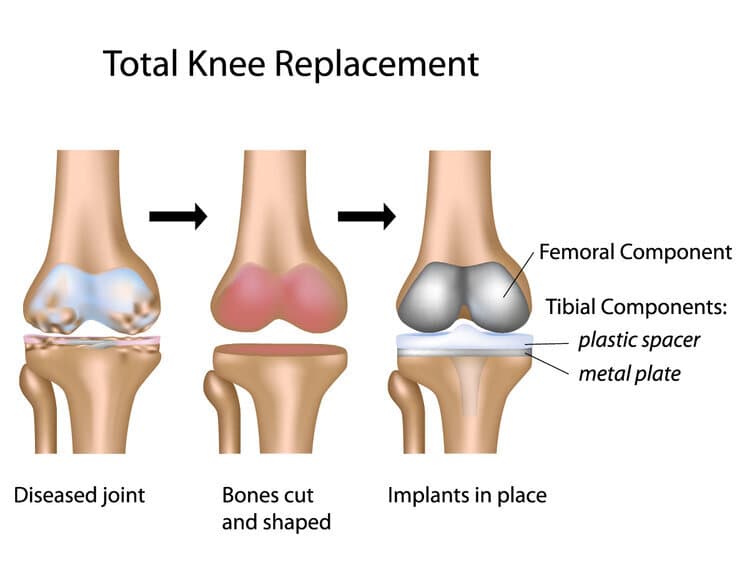
Total knee surgery (TKR) or Knee Arthroplasty is the surgical procedure to replace the damaged part of the knee with metal and polyethylene artificial implants.
During a total knee replacement, the end of the femur bone is removed and replaced with a metal implant. The end of the lower leg bone (tibia) is also removed and replaced with metal implant and in between Femur and tibia there is a polyethylene surface.
Depending on the condition of the kneecap portion of the knee joint, a plastic “button” may also be added under the kneecap surface. The artificial components of a total knee replacement are referred to as the prosthesis.
These implants mimics the natural knee movement and help a patient to get back the range of motion and reduce knee pain. The Knee replacement surgery is one of the most common bone and joint surgeries.
Is It Safe To Do Knee Replacement (TKR)?
A knee replacement (TKR) procedure is recommended by doctors in severe cases of Osteoarthritis (OA) or Rheumatoid Arthritis (RA). In these severe cases, there’s no other therapy option but to go ahead with a knee replacement surgery.
A knee replacement is one of those procedures which is quite common these days and has a huge success rate. Almost 1.75 Lacs of knee replacement surgeries are done on an average in India every year.
Considering this total number of knee replacement surgeries and huge success rate achieved for the same, we can comfortably say that this procedure is completely safe. If we are following all the guidelines during different stages of this procedure, then it won’t take long for you to enjoy your active life
How is Life After A Total Knee Replacement (TKR)?
Total Knee replacement, also called as Total Knee Arthroplasty, can relieve pain and help you get mobile and active again after a knee injury or osteoarthritis.
After surgery, most people experience significant improvements in the quality of their life, but it won’t happen at once.
It usually takes in general most people around 3 months to return to most activities, and it can take 6 months to a year to make a full recovery and regain full strength.
You will be able to carry out personal care activities and resume normal daily activities within 6 weeks and drive within 3 to 6 weeks. It may take 4 to 6 months or up to an entire year to fully get back to your previous activity levels, recover and realize total benefits of knee replacement surgery.
In other words, recovery takes time. It is crucial to have realistic expectations.
How Does Knee Replacement Surgery Recovery Go?
Knee replacement surgery is one of the important elective surgeries, which helps you get on your feet and have an active lifestyle. Recovery and rehabilitation is a crucial aspect in post knee replacement surgery phase.
12 week period is something which is followed as a milestone for recovery and rehabilitation. Structured & planned approach with a diligent exercise schedule will help you heal faster and ensure long term success

Timeline Recommended level of Activity
- Day 1- Get plenty of rest and walk a short distance with some help
- Day 2- Start sitting, change locations, walk a bit and climb few steps with some help Discharge Stand up, sit, take bathe, and dress up with minimal help. Walk further and use stairs with a walker or crutches
- Weeks 1–3 Walk and stand for more than 10 minutes. Start using a cane instead of crutches.
- Weeks 4–6 Start returning to daily activities like work, driving to nearby places, travel, and household tasks.
- Weeks 7–12 Start returning to low-impact physical activities like swimming and stationary cycling
- Week 12+ Start returning to higher impact activities if your surgeon agrees.